Introduction
Do you frequently deal with unexpected pressure drops on the factory floor? I have seen countless maintenance teams chase ghost leaks for hours, only to discover the root cause is a surprisingly simple oversight. Mismatched tubing and components. Precision forms the absolute backbone of any reliable pneumatic design. In this demanding industrial environment, push-to-connect technology is the undisputed industry standard. These components deliver the fast, tool-free connections essential for modern fluid and air systems. Yet, their long-term dependability hinges entirely on one critical factor. You must select the exact correct tube size.
Listen closely, because a fraction of a millimeter off means immediate system failure or a slow, expensive bleed of compressed air. This comprehensive guide breaks down everything necessary to master tube sizing. We will explore metric versus imperial dimensions, delve into thread compatibilities, and show you exactly how to measure your lines. This guarantees a tight, leak-proof seal for every single circuit on your floor.
Key Takeaways
- Outer Diameter is King: Push-to-connect mechanisms seal and grip based exclusively on the Outer Diameter of the tubing. They completely ignore the Inner Diameter.
- Metric vs Imperial: Standard metric sizes span from 3mm to 16mm. Imperial inch sizes typically range from 1/8 inch to 1/2 inch. With very few exceptions, these two measurement standards are never interchangeable.
- Thread Types Matter: Specifying the correct tube size is only half the equation. The port side of the connection requires matching the correct thread geometry.
- Material Compatibility: Polyurethane and Nylon remain the most common and reliable tubing materials. They offer an ideal balance of surface hardness and flexibility.
Industry Trends: Miniaturization and High-Pressure Demands
Before diving into specific sizes, we must acknowledge where the automation industry is heading. Recent engineering trends highlight a massive shift toward miniaturized, high-density automation. Machine footprints are shrinking drastically. Meanwhile, operating pressures are increasing to maximize factory throughput. This evolution means the tolerance for sizing errors has practically vanished. Precision is no longer optional. It is the absolute baseline.
Furthermore, as facilities integrate smart sensors to monitor air consumption, even a microscopic leak will trigger system alarms. Modern pneumatic air fittings are engineered specifically to handle these rigorous demands. Premium components typically support working pressures up to 1.0 MPa and operate flawlessly in temperatures ranging from 0 to 60 degrees Celsius. Understanding these exact requirements accelerates your purchasing process. It eliminates the risk of ordering incompatible parts and ultimately prevents expensive operational downtime.
Understanding Push-to-Connect Mechanics in Pneumatic Systems
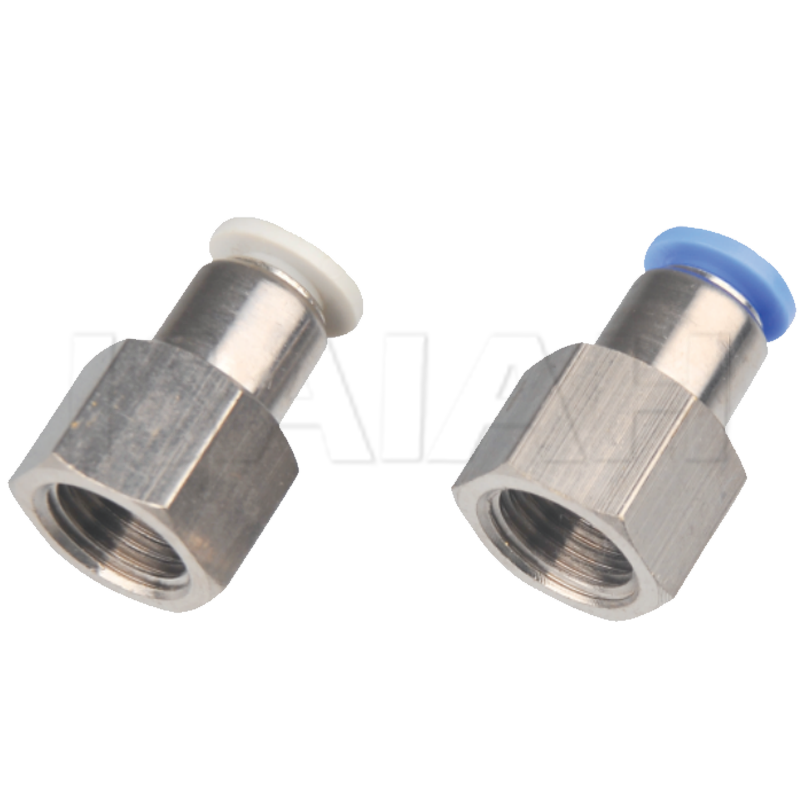
To properly size lines for your machinery, you must first understand the internal architecture of these precision-engineered devices. Inside the fitting sits a release collar, typically constructed from engineered plastic or metal. Beneath that lies a stainless steel grab ring featuring angled teeth. These teeth are designed to bite aggressively into the exterior wall of the inserted tube. Finally, an internal elastomeric O-ring compresses against the tube's outer wall to create the final airtight seal.
Because the grab ring and the O-ring interact exclusively with the exterior profile, dimensional accuracy is non-negotiable. Imagine walking past a compressor station and hearing that faint, continuous hiss. That is the sound of energy and money evaporating. This issue is often caused by an O-ring failing to properly compress around an undersized exterior wall. Conversely, forcing a slightly oversized tube will permanently damage the internal teeth. This makes secure insertion impossible.
Actionable Selection Guide: Metric vs Imperial Tube Sizes
Metric sizing represents the global standard for the vast majority of modern industrial machinery. If your equipment was manufactured in Europe or Asia, it almost certainly utilizes metric dimensions. In contrast, fractional imperial sizes remain heavily utilized throughout North America and within legacy equipment worldwide. Facilities operating older machinery must carefully manage their inventory to avoid cross-contamination.
Mixing these standards is a critical engineering error. For instance, a 1/4 inch tube has an Outer Diameter of exactly 6.35mm. Attempting to jam a 1/4 inch tube into a 6mm port will permanently deform the internal grab ring. Placing a 6mm tube into a 1/4 inch port results in a disastrously loose connection. It will instantly blow out under operational pressure. Always verify the exact standard printed on your equipment before installation.
To help you select the exact match, use this quick reference comparison table for standard sizes:
| Category | Metric Outer Diameter | Imperial Outer Diameter | Typical Industrial Application |
| Micro and Small | 3mm, 4mm, 6mm | 1/8 inch, 5/32 inch, 3/16 inch | Robotics, pilot valves, confined spaces. Note: 5/32 inch is roughly 4mm and functionally interchangeable. |
| Medium | 8mm, 10mm, 12mm | 1/4 inch, 5/16 inch, 3/8 inch | Standard directional control valves, packaging automation, general plant air. |
| Large | 14mm, 16mm | 1/2 inch, 5/8 inch | Main air supply drops, heavy-duty actuators, high-flow manifolds. |
How Thread Types Impact Your Connection Choice
The tube size represents only one side of the mechanical equation. The opposing side connects to a threaded port on a manifold, cylinder, or valve block. To achieve a secure circuit, you must specify both the correct tube Outer Diameter and the exact thread geometry.
National Pipe Thread is the predominant standard used in the United States and Canada. These threads feature a tapered design, meaning the diameter slightly decreases toward the tip. When an NPT Pneumatic Fitting is wrenched into a port, the flanks of the male and female threads wedge tightly together. This mechanical deformation creates the airtight barrier. High-quality NPT components often feature pre-coated Teflon sealant to ensure a perfect, leak-free seal upon initial installation.
Outside of North America, British Standard Pipe threads are the norm. BSPT functions similarly to NPT by creating a seal through tapered wedging. However, their differing thread angles make them fundamentally incompatible with NPT. Alternatively, BSPP features parallel threads that do not taper. Because they cannot wedge together, they rely on an embedded O-ring or a bonded washer at the base of the hex to prevent air from escaping.
Components are also categorized by their gender orientation. A male connector features external threads screwed directly into a cylinder block. Conversely, a Female air fitting features internal threads. You would typically use this configuration when connecting flexible lines to a male-threaded pipe nipple, mounting a pressure gauge, or transitioning from hard piped bulk fluid lines to flexible routing.
How to Measure Your Tubing for a Perfect Fit
When upgrading an older system, you will inevitably encounter existing lines with worn or rubbed-off printed specifications. Precise manual measurement is required to ensure compatibility with replacement parts. Desktop rulers are highly inadequate for fluid power applications. The tolerances required for a leak-proof seal are microscopic. It is mandatory to use calibrated digital calipers capable of measuring to at least two decimal places.
First, ensure the end of the tube is cut perfectly square using a dedicated tube cutter. A jagged, angled, or crushed cut created by dull scissors will distort the profile. This leads to inaccurate readings. Next, open the jaws of the digital caliper and place them gently around the outside of the tubing. Slowly close the jaws until they make flush contact with the exterior walls. Do not apply excess pressure. Polyurethane is soft. Squeezing the calipers too tightly will compress the material, giving a falsely small reading.
High-quality industrial tubing is manufactured under strict quality control to maintain a precise Outer Diameter. The accepted industry tolerance is generally plus or minus 0.1mm. If you measure lines that fluctuate wildly beyond these tolerances, the material is likely of inferior quality and will cause inconsistent gripping during operation.
Tube Material Compatibility and Reliability
The long-term reliability of a push-to-connect mechanism is heavily dependent on the physical properties of the inserted material. The internal stainless steel teeth require a surface that is pliable enough to bite into, yet rigid enough that the wall does not collapse inward under heavy pressure.
Polyurethane is the undisputed champion for general-purpose automation. It offers exceptional flexibility, high resistance to kinking, and excellent memory. Its surface hardness provides the perfect canvas for the grab ring to anchor into. Nylon is significantly harder and more rigid. Engineers choose Nylon for applications requiring higher operating pressures or exposure to harsh factory chemicals. Teflon is reserved for highly specialized environments, such as semiconductor manufacturing, where extreme heat resistance and chemical inertness are mandatory.
Not all flexible hoses are suitable for these mechanisms. Extremely soft materials, such as standard silicone or low-grade vinyl, should be strictly avoided. The sharp metal claws will easily gouge and tear these soft materials. This results in immediate blowouts the moment the compressor kicks on.
Choosing Reliable Supply Partners
At the procurement stage, recognize that the influx of low-cost, unbranded components has introduced significant risks into global supply chains. Cheap alternatives frequently suffer from weak plastic bodies that crack under machine vibration. Their internal grab rings are often made of inferior alloys that rust. Furthermore, low-grade O-rings degrade rapidly when exposed to standard compressor oils.
To protect the integrity of your factory floor, sourcing from reputable Quick Connecting Tube Fittings Manufacturers is essential. Evaluate potential suppliers based on their quality certifications and their ability to provide rigorous burst pressure testing documentation. A top-tier manufacturer will offer a comprehensive catalog featuring specialized components like manifold blocks, inline flow controls, and multiple body materials. By partnering with manufacturers who prioritize strict engineering tolerances, facilities can guarantee their pneumatic networks remain efficient and highly productive.
Conclusion
Mastering tube sizing is the absolute easiest way to ensure a highly efficient, maintenance-free pneumatic system. Always remember to measure the Outer Diameter. Never mix metric and imperial standards unless explicitly verified. Ensure your thread geometry perfectly matches your port. Armed with this knowledge, you can confidently eliminate pressure drops and keep your automated systems running at peak performance. Take the time to audit your current inventory today and ensure your specifications align flawlessly with your chosen components.
Are you ready to upgrade your pneumatic network with leak-proof precision? Visit Isaiah PC to explore a complete range of industrial-grade fittings. Match your exact specifications with our premium components and eliminate factory downtime for good.
FAQ
What happens if I use the wrong tube size in a pneumatic fitting?
Using the incorrect size compromises the mechanical seal and grip. An undersized line will fail to compress the internal O-ring, causing continuous air leaks and pressure drops. An oversized line will crush the internal stainless steel grab ring during insertion, permanently damaging the component and rendering it useless.
How do I know if my air fittings are metric or imperial?
The most reliable method is to check the markings on the release collar of the component. Metric parts typically display numbers like 4, 6, or 8. Imperial parts will show fractions like 1/4 or 3/8. If the markings are worn off, you must measure the Outer Diameter of the compatible tubing using digital calipers to determine the standard.
Can I use metric tubing in an imperial inch one-touch fitting?
Generally, no. With the rare exception of 4mm and 5/32 inch, which are functionally identical in Outer Diameter, mixing metric and imperial sizes will result in a loose fit. This mismatch inevitably leads to immediate air leaks or dangerous tube blowouts under pressure.
Do push-to-connect components seal on the inside or outside of the line?
They seal entirely on the outside. The internal elastomeric O-ring wraps tightly around the Outer Diameter of the tube. This is exactly why the Outer Diameter is the only measurement used when sizing these components for your circuits.
Why is my circuit leaking even though I bought the correct size?
If the size is genuinely correct, leaks are usually caused by three common installation errors. First, the tube was not cut perfectly straight at a 90-degree angle. Second, the exterior of the tube is deeply scratched or deformed, preventing the O-ring from creating a flush seal. Third, the tube was simply not pushed far enough into the body to bypass the internal O-ring.
What is the difference between an NPT and a BSPT thread?
While both are tapered designs meant to wedge together, they feature different thread angles and pitches. An NPT thread utilizes a 60-degree thread angle with flat peaks and valleys, common in the Americas. BSPT utilizes a 55-degree angle with rounded peaks, common in Europe and Asia. They cannot be threaded into each other without causing severe damage and guaranteed leaks.
How do I safely remove the tube from the collar?
To disengage the connection, push the plastic release collar inward toward the main body and hold it firmly in place. While keeping the collar fully depressed, pull the tube straight out. Never attempt to yank the tube without depressing the collar first. This will severely damage the internal stainless steel grab ring and ruin the component.